
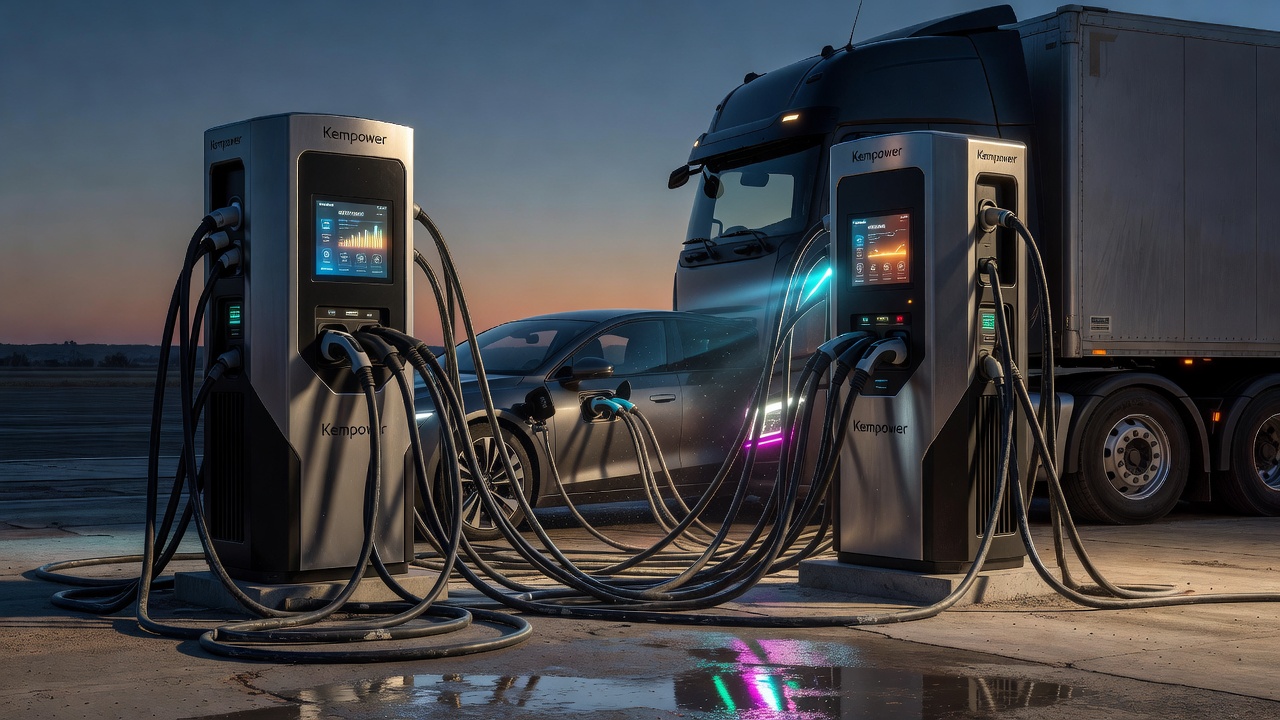
A single charging bay that can serve a passenger car one moment and a heavy-duty truck the next is no longer a concept on a drawing board. Kempower has unveiled the Mega Satellite Flex, a dispenser that supports both the established CCS standard, at up to 560 kW, and the emerging Megawatt Charging System, at up to 1.2 MW. It is the Finnish company's first product built to handle either standard from the same unit, a design choice that reflects where the charging industry actually stands right now: caught between two eras of vehicle electrification.
That in-between moment is the whole point. CCS remains the dominant plug for electric cars across North America and Europe, while MCS is only beginning to appear at depots and corridors built for electric trucks that need far more power to make long routes practical. Building two separate systems, one for each standard, has been the default approach so far, but it doubles land use, permitting, and grid connection costs. For travelers concerned about network security while on the road, the broader conversation around charging infrastructure often intersects with digital habits, too, from payment terminals at charging stations to the importance of staying safe on hotel Wi-Fi when handling banking apps or fleet management software during long-haul stops. staying safe on hotel Wi-Fi
One Site, Two Charging Eras
The Mega Satellite Flex is rated for up to 1,500 amps on the MCS side and 700 amps on CCS, with cable lengths of 5 meters for CCS and 2.7 meters for MCS. Those numbers matter because megawatt charging cables carry enormous current and need to stay short and heavily insulated for safety and thermal reasons, while CCS cables serving cars and vans benefit from extra reach to accommodate different vehicle layouts. An optional payment terminal lets operators serve public and commercial customers from the same hardware without added retrofitting.
Kempower is also framing the unit as forward-compatible with 800-volt electric vehicles, a battery architecture increasingly common in newer cars and trucks because it allows faster charging without the excessive heat and cable thickness that lower-voltage, high-current systems require. As more manufacturers adopt 800-volt platforms, chargers that cannot deliver matching voltage and current become a bottleneck rather than an asset.
Why Utilization Matters for Operators
Charging site economics depend heavily on utilization. A charger that sits idle for hours between heavy-duty truck arrivals is a poor investment, but one that can also serve passenger cars during those gaps changes the math considerably. By supporting both standards, the Mega Satellite Flex lets operators capture revenue from whichever vehicles show up first, rather than waiting for truck traffic alone to justify the investment. Kempower says the unit works with its existing distributed charging architecture, meaning operators already running its systems can add the new dispenser without reengineering their sites.
What Comes Next
Kempower introduced the Mega Satellite Flex at its Unplug & Recharge event held alongside ACT Expo, where it remains on display this week. The company expects to bring it to market in North America and Europe in July 2026, giving fleet operators, charging network builders, and site developers over a year to plan deployments around a single piece of hardware rather than two competing buildouts.