
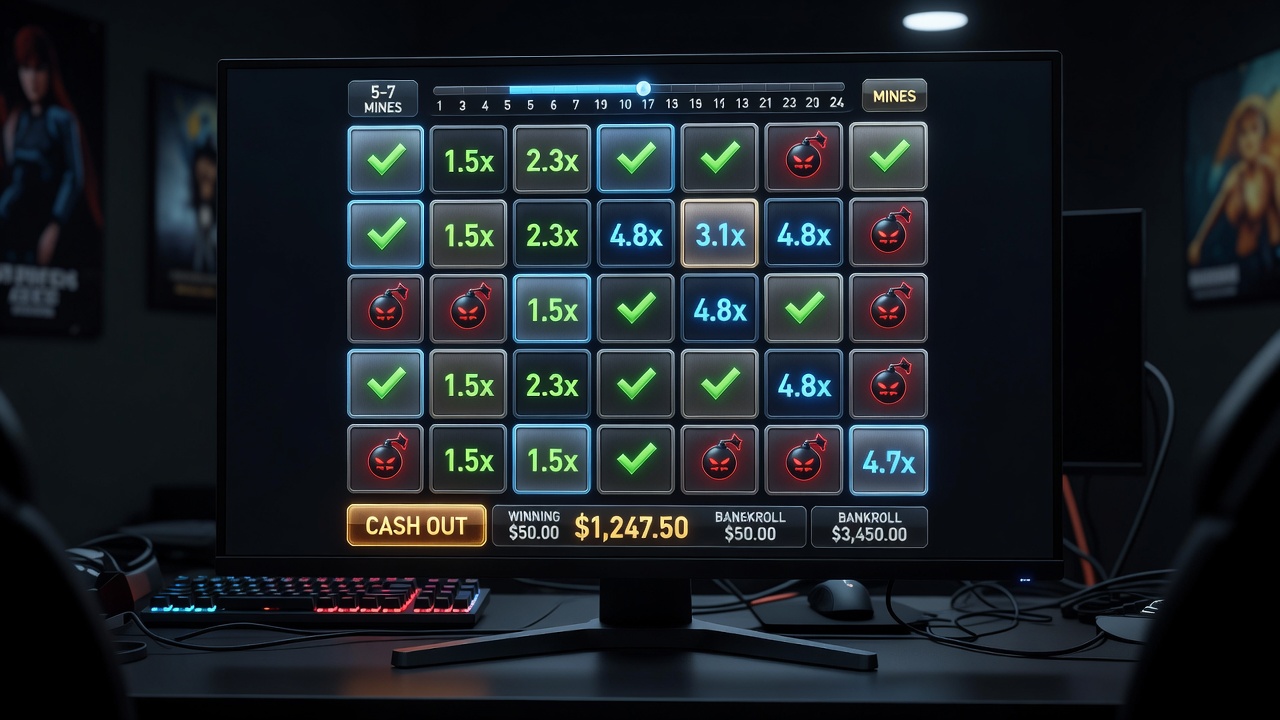
A five-by-five grid holds twenty-five hidden tiles, and behind a handful of them sits nothing but a bomb icon waiting to end your round. That single detail - the ratio of safe tiles to mines you choose before the first click - determines almost everything about how a session unfolds. Get the balance wrong and you either cash out too early to matter or push your luck straight into a loss. Get it right, consistently, and Mines becomes one of the more mathematically transparent betting games available online.
What makes this title different from a typical slot or card game is the visibility of its odds. Every tile you reveal changes the probability of the next one being safe, and that number is calculable in real time if you know what to track. Before diving into the mechanics, it's worth pointing newcomers toward a platform where the interface and payout structure can be examined directly - you can view details on how the grid, multipliers, and cash-out timing interact before risking a single bet. Once you understand that relationship, the rest of the game becomes far less about luck and far more about discipline.
This guide walks through the complete rule set, breaks down the math behind risk and reward, and lays out strategies that experienced players actually use to manage variance instead of fighting it.
Understanding the Basics: How to Play Minesweeper-Style Betting Games
Mines draws its core concept from the classic single-player puzzle, but the betting version strips away deduction and replaces it with pure probability management. There's no logical solving involved - no numbers indicating how many mines border a tile. Instead, every click is a gamble weighted by the settings you chose at the start of the round.
The Origins of the Mines Concept
The original Minesweeper puzzle asked players to use logic and numbered clues to avoid detonating hidden mines. The betting adaptation keeps the visual grid and the tension of uncertainty but removes the deductive layer entirely. Learning how to play Minesweeper in its classic form won't give you an edge here - the betting variant is a probability exercise, not a logic puzzle, and treating it as one is the first mistake new players make.
Setting Up a Round
Before each round, you set two variables: your wager amount and the number of mines hidden in the grid, typically ranging from one to twenty-four. Fewer mines mean higher odds of hitting a safe tile but smaller multiplier growth per click. More mines mean the opposite - steep risk, but multipliers that climb quickly with each safe reveal.
Reading the Multiplier Table
Each safe tile you uncover increases your potential payout according to a multiplier curve tied directly to your mine count. This curve isn't arbitrary; it reflects the shrinking pool of safe tiles remaining as you progress. Watching how the multiplier accelerates after tile eight or nine, for example, helps you judge whether continuing is worth the added risk.
Mines Game Rules Explained Step by Step
The rules of Mines are simple to state but easy to misjudge in practice. Knowing the mechanics cold is what separates a player who reacts calmly under pressure from one who panics after a near-miss.
Grid Size and Mine Placement
Standard boards use a 5x5 layout, giving twenty-five total tiles. Mine placement is randomized for every round through the platform's random number generator, meaning no pattern from a previous game carries over. Assuming otherwise is a common and costly misconception.
Cash-Out Mechanics
You can stop and collect winnings after any successful reveal, before clicking the next tile. This is the single most important rule in the entire game: multipliers only exist on paper until you lock them in. Hesitating one click too long is how modest wins turn into total losses.
What Happens on a Mine Hit
Clicking a tile hiding a mine ends the round immediately and forfeits the wager, regardless of how many safe tiles were revealed beforehand. There's no partial credit, no insurance, and no recovery mechanic within that round - the game resets entirely for the next attempt.
- Grid: 25 tiles arranged in a 5x5 layout
- Mine count: adjustable, usually 1 to 24 per round
- Cash-out: available after each safe reveal, before the next click
- Loss condition: any single mine tile ends the round instantly
Core Mines Game Strategy: Balancing Risk and Reward
Strategy in Mines isn't about predicting where bombs are hidden - that's impossible by design. It's about structuring your mine count, bet size, and cash-out timing so that your long-term results align with a risk profile you can actually sustain.
Low-Mine Conservative Play
Setting the mine count between one and three keeps the odds of hitting a safe tile high on nearly every click. Multipliers grow slowly, but the frequency of successful rounds is much higher. This approach suits players building a bankroll steadily rather than chasing a single large payout.
High-Mine Aggressive Play
Choosing ten or more mines flips the equation: each click carries real danger, but multipliers jump sharply with every safe tile. This style rewards players comfortable with high variance and willing to accept frequent losses in exchange for occasional outsized wins.
The Middle-Ground Approach
Many experienced players settle on five to seven mines as a working compromise. It offers meaningful multiplier growth without the punishing failure rate of aggressive setups. Adjusting between these tiers based on bankroll size and session goals is the essence of adaptable Mines game strategy.
How to Win Mines: Practical Techniques That Actually Work
No strategy guarantees a win in a game built on random tile placement, but certain habits measurably improve your expected outcomes over many rounds.
Setting a Target Multiplier Before You Start
Decide on a cash-out multiplier before the round begins, not while adrenaline is influencing your judgment mid-game. A predetermined target - say, 2x or 3x your wager - removes emotional decision-making from the equation entirely.
Tracking Bankroll Across Sessions
Divide your total betting budget into fixed session units rather than wagering freely. This keeps a single unlucky streak from wiping out funds meant for multiple sessions, and it forces discipline that raw enthusiasm tends to override.
Avoiding the Sunk-Cost Trap
The temptation to keep clicking after a strong run is where most losses actually happen. Recognizing that each click carries the same underlying odds regardless of previous success is critical - past safe tiles don't make the next one safer.
Complete Mines Betting Game Guide: From First Bet to Advanced Play
Moving from casual play to consistent results requires treating each session as part of a larger pattern rather than an isolated event.
Choosing a Reliable Platform
Confirm that the platform uses a certified random number generator and publishes its return-to-player percentage for the Mines title specifically. Transparency here separates trustworthy operators from ones worth avoiding entirely.
Practicing With Demo Modes
Most platforms offer a free-play version that mirrors the real game's mechanics without financial risk. Spending time here to internalize multiplier growth patterns pays off once real money enters the picture.
Scaling Bets as Confidence Grows
Start with minimum wagers while learning the rhythm of the multiplier curve, then increase bet size gradually as your comfort with risk management improves. Jumping straight to large bets before understanding the pacing is how new players lose their bankroll fastest.
Common Mistakes Players Make in Mines
Even players who understand the mechanics fall into predictable traps that erode their results over time.
Chasing Losses With Bigger Bets
Increasing wager size immediately after a loss to "win it back" ignores the fact that each round is statistically independent. This habit accelerates losses rather than recovering them.
Ignoring the Mine Count's Impact on Odds
Some players fix their mine count out of habit and never revisit whether it still matches their current bankroll or goals. Reassessing this setting regularly keeps your strategy aligned with your actual risk tolerance.
Playing Without a Clear Stopping Point
Sessions without a predefined win or loss limit tend to run longer than intended, usually to the player's detriment. Setting hard limits before starting protects both bankroll and judgment.
Frequently Asked Questions
Is Mines a game of skill or pure chance?
Mine placement is entirely random, so no amount of skill changes the odds of any single tile. Skill enters through bankroll management, mine-count selection, and cash-out timing - decisions that shape long-term outcomes even though individual clicks remain unpredictable.
What mine count gives the best odds for beginners?
Starting with one to three mines offers the highest frequency of safe clicks, which helps new players learn multiplier pacing without frequent early losses. Once comfortable, gradually testing higher counts reveals how risk and reward shift.
Can I predict where mines are hidden based on previous rounds?
No. Each round generates a fresh, independent placement of mines, so patterns from past games have zero bearing on the current one. Treating any previous outcome as predictive is a mistake that leads to overconfidence.
How much of my bankroll should I risk per round?
A common guideline is limiting individual bets to a small fraction of your total session bankroll, often between one and five percent. This keeps a single loss from significantly damaging your ability to keep playing strategically.
What's the safest way to lock in profit during a round?
Cash out as soon as you reach the target multiplier you set before starting the round. Waiting for "just one more click" after reaching your goal is the most common way players give back winnings they'd already secured.
Does the number of mines affect the game's return-to-player rate?
The underlying return-to-player rate typically stays consistent across mine-count settings on well-regulated platforms, though the variance of individual sessions changes significantly. Higher mine counts produce bigger swings, not necessarily better long-term returns.